Airbags Make a Lousy Pillow

How to Stay Awake Driving & Other Insane Tactics

Growing up, I remember watching Clark Griswold driving cross country with his family in National Lampoon's Vacation. Ellen suggests getting a hotel but Clark waves her off saying "I'm not tired. Are you kidding? I could go another 100 miles!"
Cut to Clark asleep at the wheel as their wagon runs the gauntlet of hazards, narrowly spinning through an intersection and perfectly into a motel parking spot.
And with a little Hollywood magic, nothing terrible happens.
It's a lot different than real life. I've known countless people who have had some close calls driving drowsy. From the guy who rear-ended an 18-wheeler driving back late from his girlfriend's house to the girl that flipped her Jeep after an overnight shift.
And it's not always a one-off encounter.
I worked nights with a single mom who got into 3 accidents that totaled her vehicles, in a matter of 15 months.
Eventually it got to the point where we were worried she would even make it home when we said goodbye to her at the punch clock. Of course we would ask if she was ok to drive but she always said "I'm fine." I wish I could have written this article back then and shared all the info that I found.
Because the threat is real. With around 5 hours of sleep your risk of a crash nearly doubles and with less than 4 hours it's closer to 11 times (compared to 7+ hours of sleep).
And the risk goes beyond being a shift worker.
This information applies to early morning commuters, road trippers, exhausted parents, people working overtime or frequent travelers.
Disclosure to keep lawyers happy: Don’t drive drowsy. Better off arriving late than not at all. All tips and evidence are for informational purposes only.
And like most things I write about, I have been the driver in this story, rolling the dice when I shouldn’t have. Not a proud admission, either.
I've had that thought "if I could just slap myself awake, I'll be fine."
Since we're on the same page about how serious this is, let me share a quote that a sleep doc shared during a drowsy driving lecture:
"When I die, I want to go peacefully like my grandfather did-in his sleep. Not yelling and screaming like the passengers in his car." -Bob Monkhouse, British comedian
Now, if that joke was too dark, I'll see if I can pull up that doctor's email to let him know his icebreaker needs a little work.
Despite knowing the numbers, people still get behind the wheel for one reason or another when dangerously tired. So what are the borderline insane tactics people use to increase alertness and better yet, what actually works?
"Am I Too Tired For Tricks?"
To answer this we need to look at the two forces that make us sleepy: pressure and rhythm.
Sleep pressure increases the longer you're awake, like a bathtub slowly filling up and the only way to "drain" it is by sleeping.
Rhythm is the continuous wake and sleep cycle.
Mess with one or both of them and fatigue starts messing back with a driver's performance.
Now depending on your schedule or time you hit the road, you might be more likely to be a drowsy driver. Sure, you can make some great time on your roadtrip by leaving at zero dark-thirty but just know that more drivers have accidents in the early morning because our body's rhythm is less alert.
Midnight-6am is a circadian danger zone.
So whether you're aware or not, performance gets more sluggish. And you can't solely go by how tired you feel since people aren't always in tune with it. In one study, researchers found it more common that people underestimate how drowsy they were.
Think of it like being drunk in that you might know when you've had way too much, but would you know if you were just borderline?
Hell, driving after 21 hours awake has the same driving performance as being legally drunk, so it's not a far stretch.
Don't ignore the warnings in plain sight.
They could be whispering that you're past the point where tricks would even help. The obvious signs are nodding off or eyes closed, but what other red flags should be taken seriously?
In my friend's case she had concerned coworkers asking if she was alright to drive. Sometimes it comes from other people and sometimes it's right in front of you.
Not-so-subtle signs you're too tired:
Hitting the rumble strip a.k.a. "Poor man's espresso"
Long blinks or rubbing your eyes
Forgetting the last few miles you drove
Missing a familiar turn
Frequently correcting in the same lane
Those long blinks are especially dangerous for a couple reasons. The obvious being "who's watching the road?", but behind the scenes the risk is what's known as microsleep.
Microsleep is an involuntary period of sleep that can last a couple seconds or longer where the pressure is so high that basically sleep starts creeping in. Scary part is your eyes can be open during microsleep, so forgetting some of the drive could be a warning sign that it's happening to you.
At 70mph, you'll travel an entire football field in 3 seconds.
Don't just write it off as zoning out.
If any signs in this section start happening, give up on waking up more. You're in the nap or giving up your keys territory.
Because after a certain point, feeling more awake doesn't mean you're going to actually drive safer.
It doesn't guarantee you're safe to drive but if you're not showing those warning signs, that's where the next section comes in.
Tricks With Some Science Behind Them
You could be reading this at a truck stop and wondering what the next move is. These next tricks could help.
Since sending half-asleep drivers out on the road for research is generally frowned upon (who knew?), most of this evidence is from driving simulation studies.
Breaks
Taking a break is an obvious step. Less obvious is how often and for how long. AAA Foundation recommends taking a break every two hours or 100 miles.
So get out. Stretch and move around. Basically don't do anything that's going to make you more sleepy-like quietly listening to smooth jazz or streaming a Carlos Mencia special.
To be clear, breaks might help driving performance before getting tired. They can lower drowsiness and help driving performance but without a nap or caffeine, that alertness is fleeting.
Nap
Relieving some of that sleep pressure will do you a world of good. Of course, finding a place to nap in a safe parking area is important. Once that's figured out, the next question is how long?
The ideal time is long enough to get rid of some sleep pressure but not enough that you fall into deep sleep that's hard to shake off. You know that kind of sleep that makes you think you overslept the school bus... before remembering you're not in school anymore? Yeah, that's the kind of deep-sleep fog we're trying to avoid.
For this reason, aim to nap between 15-20 minutes if possible.
Caffeine
There's a good reason that caffeine is most people's go-to on the road. It's been shown to improve everything from reaction time, accuracy and vehicle control.
Studies have shown anywhere between 80-200 mg could do the trick, but there's no single magic number. For context, 80 mg is about a small cup of coffee.
If you're headed home to day-sleep, see section "For Shift Workers" at the end.
After sleep, caffeine is king. Why not combine the two?
Nappacino aka Caffeine Nap
If you're not worried about falling asleep after your drive then this could be the best trick of the bunch.
Chug a caffeinated drink that goes down quick then immediately try for a nap. Hot drinks you sip could take too long, making it hard to nap. The science behind this trick is that as your body clears some of the sleepy feeling chemical adenosine, caffeine moves in to block its receptors.
If you've never tried it, it's an attitude adjustment and I'm a huge fan. Studies have shown it to leave you more awake than either caffeine or naps alone.
Name That Tune
Have you ever played Name-That-Tune where you guess which song & band is on the radio?
Science says to maybe give it a try.
Long driving trips can get monotonous and it's easy to fall into what's called "highway hypnosis", so adding a mild cognitive load could very well give you a secondary challenge to stay alert.
Researchers in a smaller study found that driving performance improved in drowsy subjects after playing this game. So repurpose those old power-hour mixes on YouTube to give your brain a low-level task.
Talking With a Passenger
A good passenger might help keep your brain engaged with some stimulating conversation and unlike your podcast, they can notice when you're starting to look rough. But it's not cut and dry.
Conversation can increase alertness, but passengers can also be a huge distraction. A good copilot is a great second pair of eyes that can pause when helpful instead of distracting you with cat videos.
Some people use talking on the phone as a substitute but researchers warn that since they're not there, they have no situational awareness. Imagine the person on the other end just yammering on while you're trying to navigate potential danger.
Weird side note: another study found that this boost could extend to talking to your virtual assistant if you're desperate.

Taking breaks since before it was cool.
Way Less Science
Now we're getting into the plausible range that people swear by, but there's not as much science to back it up. A lot of it comes down to increasing brain stimulation by turning up the discomfort or sensory input.
A quick search on Quora or Reddit and you'll find plenty of answers to "how to stay awake while driving?" and most of it has to do with giving your brain something to react to. They're essentially trying to blast your system awake by cranking up the volume.
These are some of those answers, though not exactly doctor recommended.
Examples include:
Make your car miserably cold
Loud music (bonus if you hate it)
Shocking food; Sour Patch Kids or spicy
Conquer a few flights of stairs or air squats before driving
Listen to trivia
Contemplate existential dread
Sunflower seeds to give your mouth something to do
Some research hints that techniques like these either don't work or don't last very long when you're tired. They might give you a little stimulation or mental engagement, but that's not the same as fixing drowsy driving.
So where do we land on keeping your brain engaged while driving, anyways?
Long and monotonous drives might let fatigue start to creep in (think of the easy listening that Clark had lulling him off to sleep). But too much mental workout and now you're pulling attention away from the road.
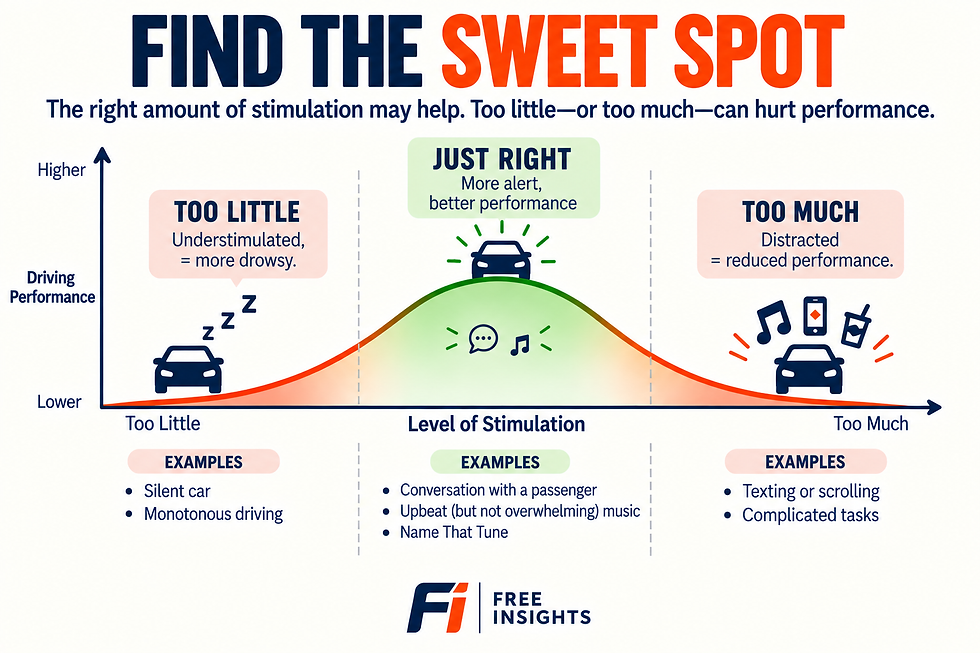
Now ask yourself: Is this stuff making you a better driver or just making you feel more awake?
Your feelings and reality may be telling a different story.
And the Asinine
Pain, physical and financial torture? As promised, here's the crazy stuff people admit to doing for that adrenaline hit to get home.
"Hung out the window like the Joker in The Dark Knight."
"Stick my hair into the window so if I fell asleep it would jerk me awake from the pain."
"Hold your wallet out the window for a second and it'll wake your ass right up."
"Increasingly harder slaps to the face."
"Hold your breath. Your brain will go into a bit of a panic mode."
Shockingly, there are no studies to back those up or dispute them. But an adrenaline shot? I'm sure they got a good scare. I mean, that one lady tied up her hair like Deuce Bigalow and still thought she was ok to drive!
But did that taste of liquid fear make any of them drive any safer?
Long Term Solutions
If you find yourself needing to dip into the safe bag of tricks often, then finding the perfect trick isn't the problem. Make sure the obvious boxes are checked by regularly getting enough quality sleep. Sometimes that's a big ask if you're jet lagged or sleeping away from home.
Try these for the long term:
Switch Drivers
Carpooling
Ridesharing
Ask work if they offer a Fleet Service
Changing your schedule
And then there's the experimental stuff.
Interestingly, creatine could help keep your edge. Two small studies found just one dose helped maintain mental performance, including processing speed, vigilance and reaction time (they did study folks that were sleep deprived but neither actually studied effects on driving, though).
For Shift Workers:
After a shift it's a balancing act between not completely destroying day-sleep and getting home alive. The goal isn't to deliver you home safely while amped up like you're testing the upper limits of pre-workout.
So think about what variables you can change. Maybe change the timing of your last caffeinated drink slightly later in your shift.
I'm a huge fan of wearing shades from the punch clock to the bedside clock. But in a pinch, take them off for a potential boost. One study found a bright light after a night shift had no simulated crashes versus dim light where 26% participants crashed.
A quick update on my coworker, she's doing well and has been accident-free after making some changes.
The bigger issue beyond figuring out creative ways to wake up when exhaustion hits behind the wheel is the crazy mental gymnastics people will go through to avoid pulling over and taking a nap.
If you’re even debating how exhausted you are and whether or not you should be driving then you already have your answer. No job, destination, or responsibilities are worth you potentially not showing up alive.
So if you find yourself saying "I'm fine" on a road trip or after pulling an all-nighter you might need to think twice or refer back to that old highway slogan:

Your Turn
Did I miss a trick or technique that you swear keeps you wide awake on a road trip? Or a ridiculous fail? Share in the comments below.

A well presented practical as well as theoretical guide of how sleep affects people. The article serves as both a what-to-do, as well as a, what-not-to-do guide, when it comes to sleep. Whether you work nights, are sleep deprived, or generally a somnolent person, you will take something from information in this article. I recommend it…in other words, I did not fall asleep once while reading it!!
Excellent read. I once pulled over on a long drive for a quick nap when I knew my sleep pressure was winning a battle that I didn't want to lose. I feel asleep in 1 second, and woke up 2 seconds later thinking I fell asleep while still driving. My body released every ounce of adrenaline I had and I wound up just driving home after that. I'll never forget that and reading this makes me realize that I should have pulled over long before I did and how lucky I really was.